


One of the most common problems reported by those working with peptides is their dissolution. Many people expect a peptide to immediately form a perfectly clear, crystalline solution when water is added. In practice, dissolution problems with peptides are not always due to the quality of the substance - very often they are related to its structure and the dissolution technique used.
To understand where these differences come from, it is useful to first look at how peptides are formed.
How are peptides created in vials?
Let us assume that we are producing 1000 vials, each containing 10 mg of a given peptide. Initially, about 10 grams of the peptide is prepared in powder form. This powder is completely dissolved in water and then - very often - mannitol is added to the solution.
Mannitol has an important technological role:
- stabilises the peptide during the drying process,
- allows a porous structure, known as a „cake”, to be created,
- facilitates subsequent dissolution.
After preparation, the solution is clear, transparent and filtered - at this stage it contains no impurities. Then, using precision equipment, the solution is dispensed (e.g. 1 ml at a time) into vials.
The next step is to freeze and then place the vials in a lyophiliser. In this device, a deep vacuum is created in which the frozen water sublimates (goes directly from a solid to a gaseous state). As a result, the dry peptide remains in the vial along with the carrier, usually in the form of a characteristic „cake”.
It is this step - freezing and freeze-drying - that has a huge impact on the subsequent dissolution behaviour of the peptide.
Why are there problems with peptide dissolution?
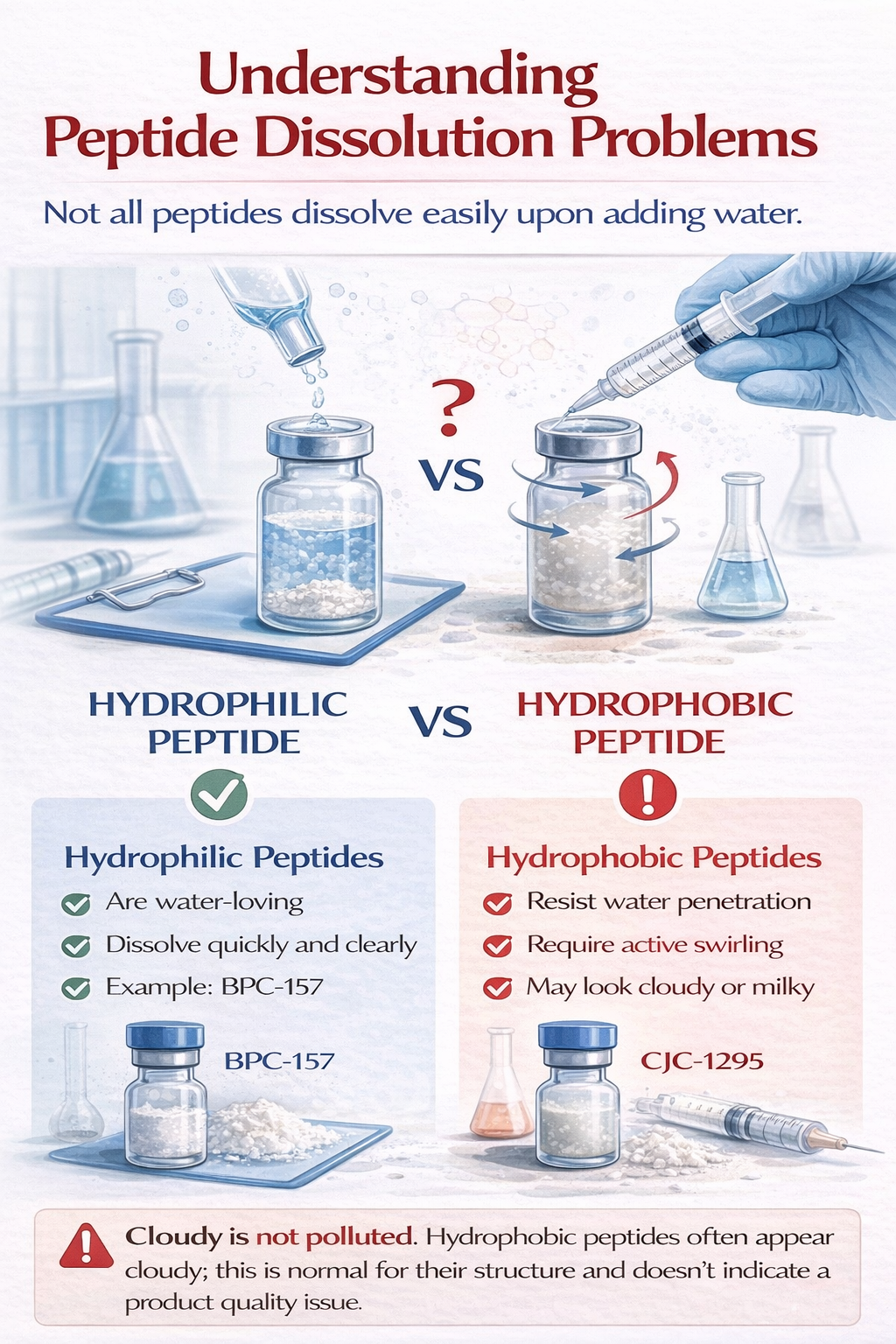
A key factor is the amino acid sequence and, more specifically, whether a given peptide is hydrophilic or hydrophobic.
Hydrophilic peptides
Peptides such as BPC-157 or TB-500 consist mainly of „water-loving” amino acids. Thanks to this:
- dissolve very quickly,
- do not require special techniques,
- the solution is clear and transparent when dissolved.
In their case, it is usually sufficient to add water.
Hydrophobic peptides
In contrast, peptides such as CJC (without DAC), Kisspeptin or AOD contain more hydrophobic fragments. This means that:
- It is more difficult for water to penetrate their structure,
- dissolving requires active action,
- the solution need not be perfectly clear.
In this case, dissolution difficulties are not a defect in the product, but a natural consequence of its structure.
How to properly solubilise hydrophobic peptides?
In the case of hydrophobic peptides, simply adding water is not enough.
The correct procedure is as follows:
- Water should be introduced into the vial relatively quickly, along the wall,
- immediately after adding water, the vial should be swirled,
- heating the vial in the hands increases solubility,
- should be stirred vigorously with a rotary motion (without shaking) until a homogeneous solution is obtained.
If the solution is still cloudy or dissolves slowly:
- a syringe with a fine needle can be used,
- gently draw and inject the fluid under low pressure.
Very important:
Stirring with a rotary motion is not the same as vigorous shaking. Shaking causes foaming, which should be avoided.
What should the finished solution look like?
This is another point that often raises misunderstandings.
- Hydrophilic peptides → solution should be clear and transparent
- Hydrophobic peptides → solution may be slightly greyish, milky or cloudy
Such an appearance is normal, as long as:
- no visible contamination,
- the solution is homogeneous
Cloudy ≠ polluted
What about precipitation after cooling?
In the case of hydrophobic peptides, it can happen after 1-2 days in the fridge:
- the solution will become slightly gelatinous,
- small aggregates will appear.
This is not a chemical problem or degradation - it is a dissolution equilibrium effect.
Before further use:
- warm the vial in your hands,
- pump the solution with a syringe,
- restore homogeneity.
It is a skill, not a flaw in the product
The bottom line is one:
The difficulty in solubilising hydrophobic peptides is not a quality defect, but is due to:
- peptide structure,
- working techniques,
- user experience.
If the solution is homogeneous and without visible particles - even if it is slightly cloudy - it is correct.
A small proportion of problem vials - what do the statistics say?
It is worth pointing out, in fairness, one other thing that is rarely mentioned but is of practical importance.
For hydrophobic peptides (such as CJC, Kisspeptin or AOD), statistically about 1-2% lyophilised vials may exhibit above-average dissolution difficulties. This is due to a combination of several technological factors, including:
- local variations in the structure of the „cake” after freeze-drying,
- uneven porosity of the material,
- micro-areas of compacted powder that are extremely resistant to hydration.
In such cases, the vial is chemically fully correct, but despite the use of correct reconstitution techniques, the problem may persist. Such situations warrant replacement of the vial.
At the same time, it should be clearly emphasised that:
- if the dissolution problem is sporadic, it may be this statistical 1%,
- whereas if three or four vials in a row behave in a similar way, it is almost certainly not a defect in the lyophilisation, but a matter of technique and dissolution skill.
In other words:
a single problematic vial happens,
A series of problems usually means that the procedure has to be revisited and corrected.
This is a normal feature of working with hydrophobic peptides and does not indicate either poor quality of the substance or its chemical degradation.